Realms of Arkania II - Star Trail
- Developer: Sir-tech Software inc.
- Publisher: Attic Entertainment Software
- Year: 1994
- System: MS-DOS
- Genre: RPG
Review
In Star Trail, you control a party of six adventurers, who are on a mission to retrieve the ancient artifact, the Salamander Stone. Actually, two seperate parties have asked you to get the Stone. One - an elf - claims the Stone is a symbol of friendship between dwarwes and elves, and as the land is in turmoil because of the Orc invasions, the artifact is sorely needed. The other party is a rich merchant who claims he can't believe in such a thing as friendship between elves and dwarwes, and he is willing to pay you one thousand gold ducats for it. Also, a sneaky fellow will ask you to find and return Star Trail, the legendary throwing axe, to the temple of the god Phex. So the game starts...
This is right after generating your characters, of course, so we'll have a look at that part. The characters are based on a highly detailed and customizable system, where you have the option to tune every little bit. That is if you're playing in advanced mode, of course, as novice mode will take care of all this for you. But being the rpg fan I am, I play advanced. Time to generate characters... There are a nice amount of different classes to choose from in Star Trail, and that's good, except for the lame female class names, like She-Rogue and She-Warrior. Also, this is another game where dwarwes and elves are treated like classes, not races, but without any big effect on gameplay, so it's passable. There are classes to cover all aspects of play, though, be it hunting through the wilderness or sneaking around towns. The character system is easy to understand and use. You basically have two options at first, which are 1) letting the game roll a finished character for you, or 2) rolling new stats to assing and edit a new character yourself. Found that the last option yields better results with a little patience. And it's a good idea to do it, too, since all main attributes seem to be actively used in this game. It won't really do having a fighter that's super stupid, as he'll fail many actions. Same goes for spellcasters, who'll have trouble doing various tasks, and will even fail spells, if their non-primary attributes are low. This is a nice turn of events opposed to many other games where fighters only use strength and mages only use intelligence. On top of the normal attributes are the negative attributes, like avarice, necrophobia and violent temper. These will surely cause you some grief at some point during the game when a character fails to hold a negative trait in check. All in all, this is one of the more realistic systems.
If playing advanced, you'll now have the option to fine-tune all skills and spells for the various characters. Some classes are better at some skills and spells than others. But with this system it's possible to actually train each character in skills not automatically available. And believe me, there are loads of skills and spells. Here comes an annoyance, though... You'll have to grab the manual lots of times to get any idea what most of the spells do, as many of the names are obscure at best. Names like Solidirid, Claudibus, Fulminictus and Bambaladam.
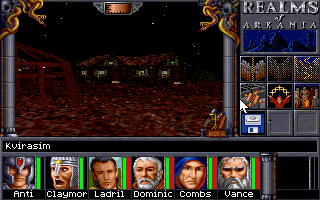
But anyway, now that you've generated a party and spoken with the first two guys (mentioned in the top), you'll be seated at a tavern and get the first idea of the interface. It's quite simple; a main window for images and moving around, a panel with up to 9 buttons to the right and the character portraits at the bottom. Also, you can bring up a menu with the same options by rightclicking or pressing page up. You'll be using it a lot, so get aquainted with it. After maybe talking with a few people - which actually is more hearing what they say about different subjects before they rudely leave you - you can venture into the town. You'll meet the 3D view you'll navigate all towns and dungeons with. One major improvement over the first game in the series, is that you can set it to smooth movement.
The character sheets are highly detailed, and you'll get to tinker with attack and parry values, use skills and item management from here. There are also a few more inventory slots available since the first game.
Moving around is easy, and there's a great automap function, fully with zooming and notes for various places and buildings. After moving around a bit, you'll notice that most buildings (90%, maybe) hold the exact same encounters, which are badly drawn people saying something most people probably won't understand. But there are, of course, lots of taverns, inns and shops of different kinds where you can buy, sell, talk, steal, perfom, cheat, brew magical potions and various other things to do. When shopping, you pick out stuff you want, and then you get a character to haggle for the price. At taverns you can cheat to earn some extra cash, but watch out, as you'll get a beating if you get caught. Lots of skills to use at various locations and in various situations. Most happen automatically, though.
After exploring the town you will be traveling to other places. Overland travel is done on the main map, following lines on the map to the next location. The travel part itself quickly becomes a little repetitive, as you'll be doing the same actions many times over. Each day of marching ends in a camp setting where you tell each character what to do, which could be hunt for food and water, gather herbs or stand guard. All of these are essential actions, as you'll easily be assaulted by wandering monsters or warbands during the night. Another point is food and water. if you don't have enough of either, you'll probably die from thirst or hunger pretty quickly. Herbs are used for treating one of the numerous diseases you can contract during play. These will come through weatherchanges, wounds, bites from animals or falling in rivers. Some might even develop into worse conditions. All in all, you'll spend a lot of time doing the same tasks while traveling.
But let's get back to the wandering monsters.. Which will usually lead to combat. This part is pretty nicely done with an isometric view. Each character has a certain amount of moves and actions they can do. You can control each individually, or you can make the computer fight for one or all characters. The good part here is that you can let your fighters to autofighting while you apply your mages with more tactics so they're most effective.. And so they don't go into hand to hand combat with ogres after running out of astral points.
Letting the computer fight at the start of the game usually will get you killed, though. There are MANY ways of winning a fight if you have the right number of fighters and different spellcasters. Many interesting spells and tactics to choose from. Another major improvement here, opposed to the first game in the series, is that you'll get to fire spells and arrows diagonally. Later on many of the fights will also become a little repetitive, so it's lucky that the main and side quests are interesting. You'll be in doubt what to do right from the beginning, but you'll get hints along the way. There are many random encounters and set sites to visit, and many have more than one entry point. Most of the quests are very linear when started, though. Some places are true showstoppers, though, as you'll suddenly find one of your partymembers going off a cliff to fall to his death or something equally deadly/annoying. I can't stress how important it is to save often in this game. You weapons will break, you'll die of thirst, your boots will be worn through and your characters will get diseases. As said before, these are fairly cool the first few times they happen, but they get tedious along the way. I have to say, though, that the puzzles in this game are luckily a little more than "go there, get item, get back here, get money". Some of the puzzles are unique and pretty hard to solve. Also, the dungeons are great, and you always seem to find new and interesting items. Some are magical, too, but even if you've identified them, they'll still just be named "Sword" and other normal names. You'll need good inventory management to be in control. You'll meet several NPCs that will offer to join you, but you can only have on tag along at a time. Don't worry, most will leave you when it's most annoying, or get killed in battle acting stupidly. They'll happily charge into the midst of an orc horde to get surrounded. Good for bait, though.
Another thing is alchemy. You'll find some recipes along the way, but most brews are either useless or costs too much money or inventory space (which means moving around items a lot) to be feasible. Mostly it's just better selling off stuff you find (like herbs, which are damn expensive) and buy the various brews. Here's another nice bit, though.. Poisons. You can poison your weapons and arrows to great effect. But even the poison will wear off over time, so use it quickly.
I've covered a few things here, but there are loads more to do, and many things to experience. And despite the repetitive tasks and minor annoyances, the game is really catchy. The sounds are ok, but not really great, but the music adds some good atmosphere. Especially the travel and battle themes. If you can get hold of the CD-version of the game, you should do so, as you'll get more sounds and digitized speech for bigger encounters. You'll probably be able to get the Realms of Arkania trilogy somewhere, which contains all the games in the series, Blades of Destiny, Star Trail and Shadows over Riva. If you're an rpg fan, you'll not find this a waste of money. And as we all know, better sounds = better game, so get the damn cd version. Not to mention that you'll get the manual and map which are quite useful. But, this version is fully playable, and you won't lose too much without the extra sounds. It has a nice replay value, too, since when you finish it - which will take a long time, most likely - you can just pick a new set of classes and do the game over. You'll need to apply different tactics when using other classes.
And again, despite the many small flaws, there are many good points to this game, and I really can't recommend it enough. It's given me many, many hours of enjoyable gameplay.
NOTE: When the copy protection dialog comes up, just type any word.
reviewed by admin
Screenshots
Click to view gallery (1 images)